Introduction
As we enter an era increasingly defined by technological advancements, the incorporation of artificial intelligence (AI) into the workplace marks a significant transition in how jobs are conceived and executed. AI is no longer an abstract notion relegated to the realms of science fiction; it has become a potent force that reshapes industries, tasks, and skill requirements across various sectors. Organizations are swiftly integrating AI solutions to enhance productivity, streamline operations, and gain competitive advantages. This integration prompts a need for understanding the profound implications that AI has on the workforce.
Within this evolving landscape, it is essential to recognize not only the risks associated with AI adoption in the workplace but also the numerous opportunities it presents. The fear often surrounding job displacement due to automation is legitimate; however, it is equally important to consider how AI is also creating new roles and opportunities for individuals willing to adapt. Jobs that rely heavily on routine and repetitive tasks are at the highest risk of being automated, yet many new positions may emerge as a direct result of AI technologies—roles that require creativity, emotional intelligence, and complex problem-solving abilities.
Furthermore, as workers navigate this shifting terrain, strategic career planning becomes indispensable. Individuals must assess their skills and identify areas for growth that align with the demands of an AI-enhanced workplace. Continuous learning and adaptation are crucial in ensuring that employees remain relevant and competitive. This blog post will delve into these themes, exploring the intricate relationship between AI and the labor market, analyzing the associated risks and opportunities, and offering guidance on effective career planning strategies in a world increasingly dominated by artificial intelligence.
AI’s Transformation of the Workplace
In recent years, artificial intelligence (AI) has emerged as a significant force reshaping the workplace across various industries. Through technologies such as automation, machine learning, and data analysis, businesses are experiencing profound changes in how tasks are executed, leading to enhanced workflow efficiency and productivity. Automation, for example, enables the delegation of repetitive and time-consuming tasks to machines, allowing employees to focus on more complex and creative aspects of their roles. This paradigm shift not only streamlines operations but also aids in reducing operational costs.
Machine learning, a subset of AI, further contributes to this transformation by enabling systems to learn from data patterns and improve their performance over time. For instance, industries such as finance leverage machine learning algorithms to analyze vast amounts of data, identifying trends and potential risks faster than any human analyst could. Similarly, healthcare organizations use machine learning models to predict patient outcomes and improve diagnostic accuracy, thereby elevating the standard of care.
Data analysis is another critical area where AI is making an impact. Businesses across sectors are increasingly utilizing AI-powered tools to gain insights from their data, helping them make informed decisions. These tools can process large datasets quickly and identify correlations that might otherwise go unnoticed. As a result, organizations can respond to market changes more effectively and develop strategies based on real-time information.
The implications of AI’s integration into daily tasks are significant. Enhanced productivity means that employees can allocate their time towards strategic projects that require critical thinking and creativity. While there are valid concerns regarding job displacement due to automation, it is essential to recognize that AI can also create new opportunities for employment in areas such as AI management and data interpretation. By adapting to these new technologies and investing in upskilling, the workforce can thrive in this evolving landscape.
Opportunities Created by AI
The advent of artificial intelligence (AI) has significantly transformed the employment landscape, leading to the creation of numerous job opportunities across various sectors. As businesses increasingly adopt AI technologies, there is a rising demand for professionals who can implement, manage, and optimize these systems. New roles such as AI specialists, machine learning engineers, and AI ethicists are emerging, necessitating the development of specialized skills in programming, algorithm design, and data ethics.
Moreover, the field of software development is evolving to accommodate AI frameworks, leading to a surge in demand for software developers familiar with AI and machine learning tools. This transition not only secures jobs for developers proficient in traditional programming languages but also opens doors for those who can create intelligent systems capable of autonomous learning and decision-making.
Data analysis is another pivotal area benefiting from AI advancements. As organizations generate and collect immense amounts of data, the need for skilled data analysts who can leverage AI-driven analytics tools becomes imperative. These analysts play a crucial role in interpreting data, providing valuable insights, and driving data-informed decision-making within companies.
Various industries are rapidly evolving to embrace AI innovations. Healthcare, for instance, is integrating AI to improve diagnostics, treatment plans, and patient care. The finance sector utilizes AI for fraud detection and risk assessment, while the manufacturing industry leverages it for automation and process optimization. Each of these advancements not only enhances operational efficiency but also creates diverse career prospects for professionals willing to adapt to these technological changes.
As AI continues to evolve, the job market is expected to reflect this transformation by offering myriad opportunities for those equipped with the right skills. Individuals who proactively seek training in AI-related fields will be better positioned to take advantage of these emerging roles, ensuring a promising career trajectory in an increasingly automated world.
Risks Associated with AI in the Workplace
The integration of artificial intelligence (AI) into the workplace is rapidly reshaping the job landscape, while simultaneously generating concerns regarding job displacement. As AI technologies advance, they are increasingly capable of performing tasks that were traditionally executed by human workers. This shift poses a considerable risk, particularly in sectors where routine and repetitive tasks dominate.
Industries such as manufacturing, transportation, and customer service are among the most vulnerable to automation. In manufacturing, for example, robots and AI systems can efficiently handle assembly line tasks, reducing the need for manual labor. Similarly, the transport sector faces possible disruptions with the advent of autonomous vehicles, which could render many driving jobs obsolete. Moreover, in customer service, AI chatbots are increasingly utilized for handling inquiries and complaints, potentially displacing roles that require human interaction.
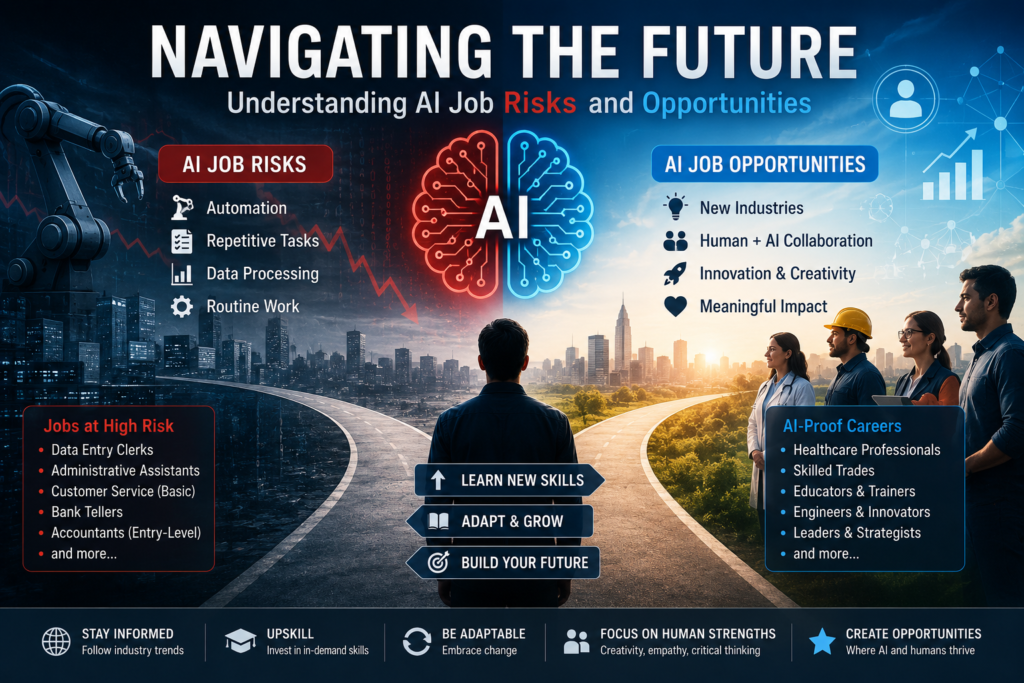
Furthermore, jobs requiring low to medium skill levels are at higher risk. Positions such as data entry clerks, assembly line workers, and even certain administrative jobs face the threat of redundancy as AI continues to streamline operations. Conversely, roles that depend on complex decision-making, creativity, or emotional intelligence are likely to remain secure since they are more challenging for AI to replicate effectively.
It is essential to acknowledge these risks and the implications they have for the workforce. Adaptation to these changes will require a proactive approach, including reskilling and upskilling initiatives to prepare workers for emerging roles in an AI-enhanced job market. Job displacement due to AI should prompt individuals and organizations alike to critically evaluate their career paths and develop strategies to mitigate these risks.
Jobs with High AI Risk
As artificial intelligence continues to evolve, certain job sectors are becoming increasingly vulnerable to automation. Notably, roles in manufacturing, retail, and administrative support are experiencing significant AI-driven disruption. This section explores specific jobs within these industries that are highly at risk of being replaced.
In the manufacturing sector, positions such as assembly line workers face substantial threats from robotics and AI. According to a report by McKinsey, up to 73 million jobs in the U.S. manufacturing industry could be automated by 2030. Robots equipped with advanced AI capabilities can perform repetitive tasks with precision, consistency, and efficiency, making human labor less desirable for these functions.
Retail jobs, particularly cashiers and stock clerks, also show high susceptibility to AI interventions. The rise of self-checkout machines and automated inventory management systems has already started transforming the retail landscape. Data from the Bureau of Labor Statistics suggests that cashiers are among the most common jobs in the U.S., with approximately 3.5 million people employed in this role, making it a significant target for AI automation.
Administrative roles, including data entry clerks and personal assistants, face an escalating risk of displacement as well. Software equipped with AI can automate data processing, streamline information management, and enhance scheduling tasks, thus reducing the need for humans in these positions. A study released by Oxford University predicted that nearly 47% of total U.S. employment opportunities are at risk due to automation, particularly in these administrative functions.
In conclusion, the ongoing advancements in AI technology pose considerable risks to jobs within manufacturing, retail, and administrative sectors. It is crucial for workers in these industries to understand these changes and proactively consider strategies for career adaptation and growth as AI reshapes the future of work.
AI-Proof Careers: In-Demand Professions
As artificial intelligence (AI) technology evolves, it raises concerns surrounding job displacement across various sectors. However, certain professions are poised to remain in high demand, providing stability for workers seeking AI-proof careers. These professions typically involve skills that are difficult for AI to replicate, emphasizing human interaction, creativity, and critical thinking.
One of the primary areas of growth is in the skilled trades. Careers such as electricians, plumbers, and carpenters are not only essential but also resistant to automation. Skilled tradespeople enjoy competitive salaries ranging from $40,000 to over $70,000 annually, depending on experience and location. The U.S. Bureau of Labor Statistics predicts strong job growth in these fields driven by consistent demand for maintenance and construction work.
Healthcare professionals represent another sector that is likely to thrive despite advancements in AI. Roles such as registered nurses, physical therapists, and healthcare administrators require a high degree of empathy and human interaction, which AI cannot effectively replace. The salary for registered nurses averages around $75,000 per year, with a projected job growth rate of 7% through 2029, indicating a highly favorable outlook.
In the education sector, teachers, counselors, and educational administrators will be increasingly valuable. These roles benefit from interpersonal skills and the ability to adapt teaching methods to individual student needs. According to current data, educators can expect salaries between $45,000 to $80,000, depending on their position and experience, with steady demand projected in the coming decade.
Engineering, particularly in fields such as civil, mechanical, and software engineering, continues to be a crucial area of employment. Engineers not only design systems and structures but also solve complex problems that require innovative thinking. Median salaries for engineers can exceed $80,000 annually, alongside a positive job outlook fueled by ongoing technological advancements.
Lastly, leadership roles across various industries remain indispensable. Effective leaders are vital in navigating the complexities introduced by new technologies while fostering team dynamics. Salaries for leadership positions can range significantly, often exceeding $100,000, reflecting the high demand for skilled leaders in an AI-influenced future.
Future-Proofing Your Career
In the evolving landscape of employment shaped by artificial intelligence and automation, future-proofing one’s career is more imperative than ever. The ability to adapt and thrive amidst technological changes can significantly enhance job security, ensuring that workers remain relevant in their respective fields. Here are some actionable strategies individuals can implement to safeguard their careers against AI-related disruption.
First and foremost, embracing a mindset of continuous learning is essential. Workers should seek out opportunities for upskilling and reskilling that align with the current demands of the labor market. Platforms like Coursera, edX, and LinkedIn Learning offer a plethora of courses that focus on in-demand skills such as data analysis, digital marketing, and programming. By actively pursuing further education, individuals can not only enhance their existing capabilities but also expand their knowledge into emerging areas.
Networking is another vital component in future-proofing one’s career. Engaging actively with professional communities allows individuals to stay informed about industry trends and job opportunities. Attending workshops, webinars, and industry conferences not only aids in personal development but can also build connections that prove beneficial when seeking new roles or collaborations.
Moreover, adaptability is key in this evolving job environment. Being open to exploring alternative roles or industries can provide new avenues for career growth. As AI continues to transform various sectors, many roles will evolve, creating hybrid positions that require a combination of skills. Workers should be prepared to pivot and embrace these changes, refining their career aspirations in light of technological advancements.
In conclusion, future-proofing your career involves a proactive approach that includes continuous learning, networking, and adaptability. By prioritizing these strategies, individuals can navigate the complexities of the modern workplace, ensuring their careers remain resilient in the face of inevitable AI disruption.
Essential Skills and Certifications for Career Advancement
As the job market continues to evolve under the influence of artificial intelligence, it becomes vital for professionals to adapt by acquiring new skills and certifications. This not only enhances employability but also prepares individuals for the challenges brought forth by automation and AI technologies. In an AI-driven job landscape, critical thinking and problem-solving skills emerge as paramount. Professionals must demonstrate an ability to analyze complex data, derive insights, and make informed decisions based on AI-generated outputs.
Furthermore, proficiency in data literacy is essential. Understanding how to interpret data analytics and using various analytical tools will be increasingly important across many industries. This shift in focus calls for individuals to engage in educational programs or workshops that cover foundational and advanced data science concepts.
Another valuable skill set encompasses tech-savviness. Familiarity with AI concepts, machine learning principles, and programming languages such as Python or R can provide a significant edge in the job market. Online platforms like Coursera and edX offer courses specifically designed to help individuals gain these crucial technology-related skills.
In addition to core skills, obtaining relevant certifications can prove beneficial for career advancement. Certifications from recognized organizations, such as Microsoft Certified: Azure Data Scientist Associate or Google Data Analytics Certificate, signify a commitment to professional growth and adaptability. Moreover, many tech companies now offer training programs that foster skills aligned with their evolving work environments.
For qualitative advancements, soft skills like communication, teamwork, and emotional intelligence are increasingly valued. Employers often prioritize candidates who can collaborate effectively in multidisciplinary teams and communicate complex ideas clearly. Recognizing the importance of these competencies, individuals seeking career advancement should consider developing them through specialized workshops or mentorship programs.
Conclusion and Career Planning Tips
In reviewing the landscape shaped by artificial intelligence (AI), it is crucial to acknowledge both the job risks and opportunities that arise from its advancements. As discussed, the integration of AI in various sectors is transforming traditional job roles, rendering some positions obsolete while creating new ones that demand different skill sets. This shift requires individuals to remain adaptable and proactive in their career planning. In an era where AI is rapidly evolving, relying on static career trajectories is no longer viable.
Career planning should involve a continuous learning approach, where individuals invest in upskilling and reskilling themselves. By embracing lifelong learning, professionals can equip themselves with the tools to navigate an AI-driven world. Identifying transferable skills and focusing on areas that AI cannot fully replicate, such as creativity, emotional intelligence, and complex problem-solving, will enhance one’s employability in the future labor market.
Networking remains a valuable asset in this dynamic environment. Building and maintaining a robust professional network can open doors to new opportunities and provide insights into industry trends affected by AI developments. Additionally, considering a diverse range of career paths can help mitigate the risks associated with job displacement caused by automation.
Actionable tips for navigating your career path in light of AI advancements include regularly assessing your skills against market demands, engaging in professional development workshops, and remaining informed about technological trends within your field. By proactively shaping your career strategy, you position yourself better within a workforce that continually adapts to new technological influences.
Ultimately, embracing the transformative nature of AI while preparing for potential disruptions will play a pivotal role in ensuring career longevity and fulfillment. With thoughtful planning and a commitment to continuous growth, individuals can effectively harness the opportunities presented by the future of work.